VRM Agent
A production-grade AI SaaS for vacation rental operations — designed, built, and tested solo in three weeks.
In brief: I built the backend of VRM Agent — an AI-powered operations assistant for vacation rental managers — working solo and spec-first. At build close: 849 automated tests, 40 of 40 end-to-end integration checks, zero failures. This case study is about how it was built, because the method is what I bring to client work.
The problem
A professional vacation rental manager handling 10 to 75 properties runs their operation across four to six disconnected tools — one for guest messaging, another for cleaning schedules, a third for maintenance, a fourth for reviews. None of them talk to each other.
The cost of that fragmentation is missed catches. A guest question at 11pm that doesn’t get answered until morning. A cleaner who never confirmed the turnover. A maintenance issue buried in a text thread until the next guest finds it. Each miss is a refund, a bad review, or a lost rebooking.
VRM Agent replaces that stack with one system: 24/7 AI guest communication, automated cleaning coordination, and structured maintenance intake — working across Airbnb, VRBO, and direct bookings, run from a single dashboard.
It’s my own product, currently pre-launch. I’m presenting it here as a case study rather than a live demo, because what’s relevant to the work I do for clients is the engineering method behind it.
What I set out to build
The MVP scope was three operational pillars, each fully automated:
- Guest communication — AI handles inbound guest messages day and night, with urgent issues escalated to the manager and maintenance requests routed into the work-order system automatically.
- Cleaning coordination — checkout detection triggers cleaner dispatch by SMS, with checklist delivery, completion tracking, and no-response escalation handled without manager involvement.
- Maintenance intake — issues are classified by priority, turned into structured work orders, and surfaced to the manager at the right urgency tier.
The target was never “a working demo.” It was production-grade architecture: multi-tenant from day one, secure, and built to scale to SaaS.
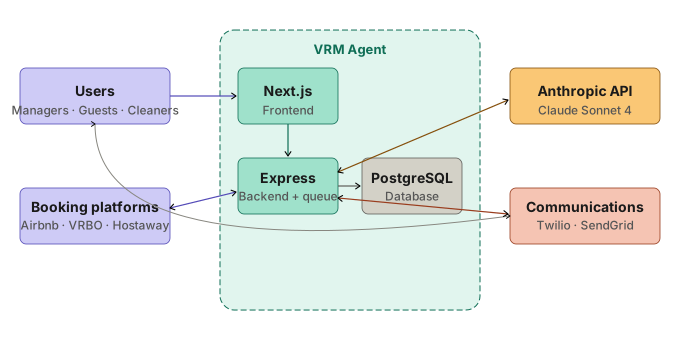
How I built it — spec-first, AI-orchestrated
I don’t hand-write code. I architect systems, write detailed specifications, and orchestrate AI development tools to build against them. The discipline lives in the specification, not the typing.
For VRM Agent that meant writing three things before any code existed:
- a product requirements document defining every feature and its behavior,
- an architecture document locking in the technical decisions — multi-tenancy, encryption, webhook security, the job queue — and the reasoning behind each,
- and 62 atomic implementation tickets, each with explicit acceptance criteria.
Those documents aren’t write-ups produced after the fact. They’re the actual artifacts the build ran on, and they’re published in the repository. The AI builds; the specification governs what “correct” means; my testing background verifies it against that standard.
That’s the part that transfers to client work. The method is repeatable. It doesn’t depend on the vacation rental domain — it depends on knowing how to decompose a product into specifications precise enough to build from, and how to verify the result.
The judgment call
Partway through the build, I hit a wall that wasn’t in the plan: Airbnb’s public API is closed to new developers. The integration path I’d architected couldn’t be opened.
The options were to dead-end the integration layer or to re-route it. I researched the alternatives and made the call to pivot to Hostaway — a channel manager that provides the connectivity Airbnb’s direct API no longer offers new entrants. The core product didn’t change; the integration strategy did.
I’m including this deliberately. Building software to spec is table stakes. The harder, more valuable skill is recognizing when a plan has hit a real constraint and changing course without losing the project — and that’s a judgment call clients are actually paying for.
What it proves
At Sprint 4 build close, verified in a formal QA report:
- 849 automated tests, zero failures — 409 backend, 440 frontend.
- 40 of 40 end-to-end integration assertions passing — the complete operational lifecycle, from booking webhook through cleaning dispatch to review-draft generation, tested as one run.
- 62 tickets delivered across 4 sprints, every one accepted against its acceptance criteria.
The numbers matter less as a scoreboard than as evidence of how the work was done: planned, decomposed, tested, and verified — not assembled and hoped over. That discipline comes from six years in QA engineering and test automation, including leading a 15-person end-to-end testing team. I build the way I used to test.
See the work
The full backend, the planning documents, and the QA report are public:
github.com/smaadallah/vrm-agent-backend
The README is the fastest orientation. The PRD, architecture document, and tickets show the spec-first method in practice. The QA report covers the full test results and sign-off.
Get in touch
I’m available for freelance AI build work — taking products from specification to tested, production-grade software.
- Email — samira.maadallah@gmail.com
- LinkedIn — linkedin.com/in/samira-maad-allah
- Freelancer.com — freelancer.com/u/samiramaad